Impact moling
BS 5837:2012 · Clause 7.7Connect below.
Preserve above.
Install pipes and ducts beneath paths, driveways and lawns without opening a continuous trench.
Discuss your siteSchematic illustration. Method and dimensions depend on the site.
BS 5837:2012 · Clause 7.7
Services through
root protection areas.
Impact moling is one of the trenchless options identified in Table 3. We assess ground conditions and alignment before proposing it.
The standard recommends:
Plan the route.
Keep services outside RPAs where possible; otherwise consider shared ducts. Locate inspection chambers outside the RPA.
Cross with care.
Agree detailed routes with the project arboriculturist. Use trenchless installation, with entry and retrieval pits outside the RPA.
Retain the roots.
Shallow runs may use hand-held excavation where roots can be retained and protected. Clause 7.2.1 prefers compressed-air soil displacement.
The method & the benefit
Careful work starts with the right method.
Install new pipes and service ducts beneath paths, driveways and lawns while avoiding a continuous open trench. Impact moling uses a pneumatic boring tool to create an underground route between launch and reception pits, reducing surface disturbance, spoil and reinstatement work on suitable sites. It is particularly useful where paving, established landscaping or access would make conventional trenching disruptive. Our Central London approach combines compact equipment with careful route planning, utility checks and assessment of ground conditions. Where trees are nearby, the proposed alignment must also respect arboricultural requirements. Tell us what needs connecting, and we will assess the options.
Where it can help
Made for
sensitive ground.
- New service ducts across established gardens
- Water-pipe routes beneath suitable paths and lawns
- Connections beneath driveways and landscaped surfaces
- Sites where extensive reinstatement would be disruptive
Before work starts
The site
sets the method.
- An assessed route between launch and reception pits
- Existing services, trial holes and required clearances
- Ground conditions, obstacles and suitable pipe sizes
- Tree constraints, alignment and reinstatement of access pits
From the garden to the ground
Two pits.
A considered route.
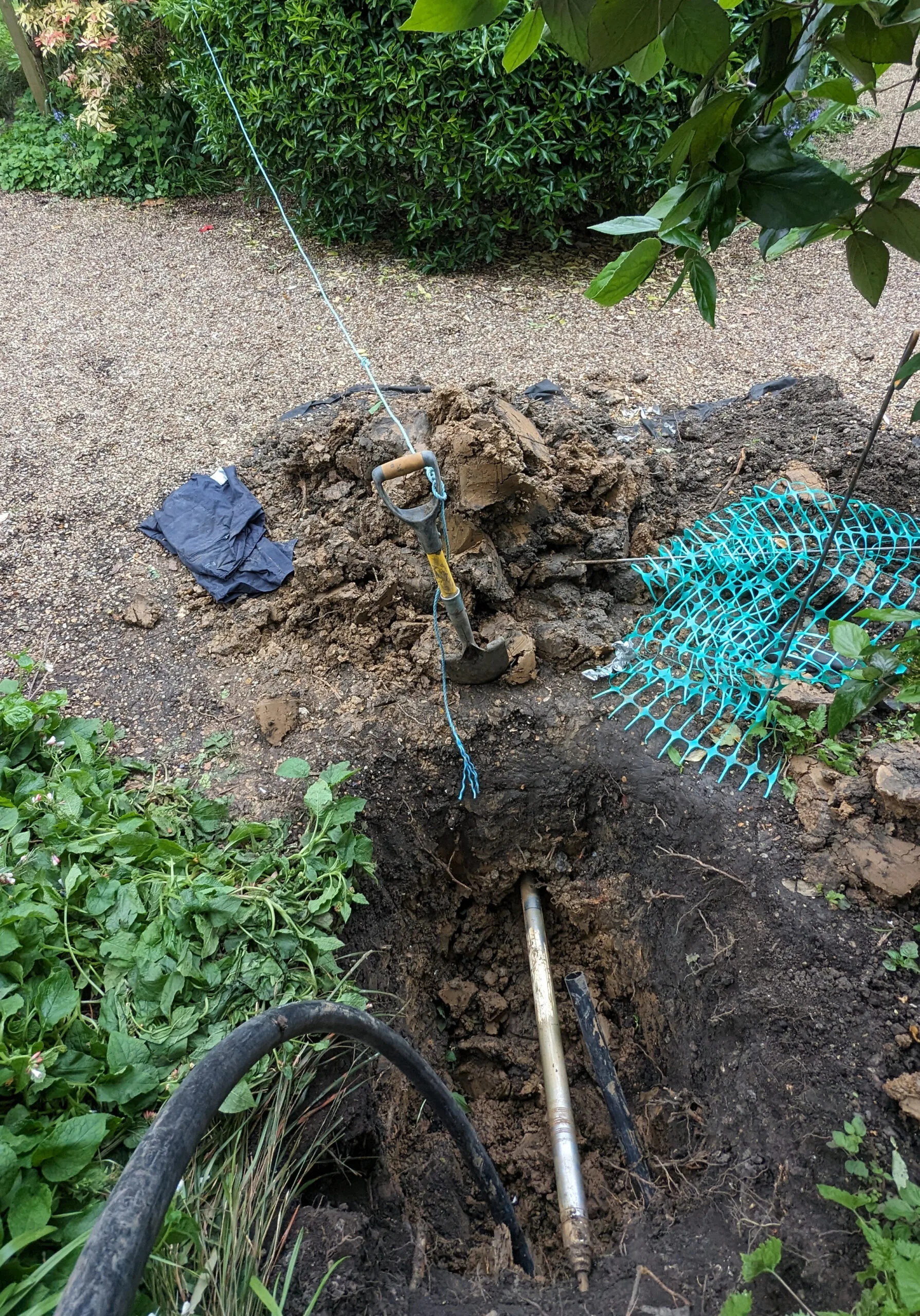
Small access points can make a substantial difference to the amount of paving, lawn or planting disturbed. The aim is to preserve the surface between them, where the assessed route and ground conditions allow.
Working near established trees ↗Good questions
Know where
you stand.
Does impact moling mean no digging?
No. Launch and reception pits are required, and extra investigation pits may be needed to locate services. The advantage is avoiding a continuous trench along the full route.
Can the mole steer around roots or utilities?
An impact mole is aimed along a straight route; it does not steer around obstacles. The route must be assessed in advance. If it cannot be made suitable, a different method or alignment is needed.
Is moling automatically suitable inside a root protection area?
No. Trees, ground conditions, access pits and the proposed alignment all need assessment. Where relevant, the method must be agreed with the project’s arboricultural adviser and comply with site-specific requirements.
Central London · Specialist ground works